
#07 - The Distant Messengers
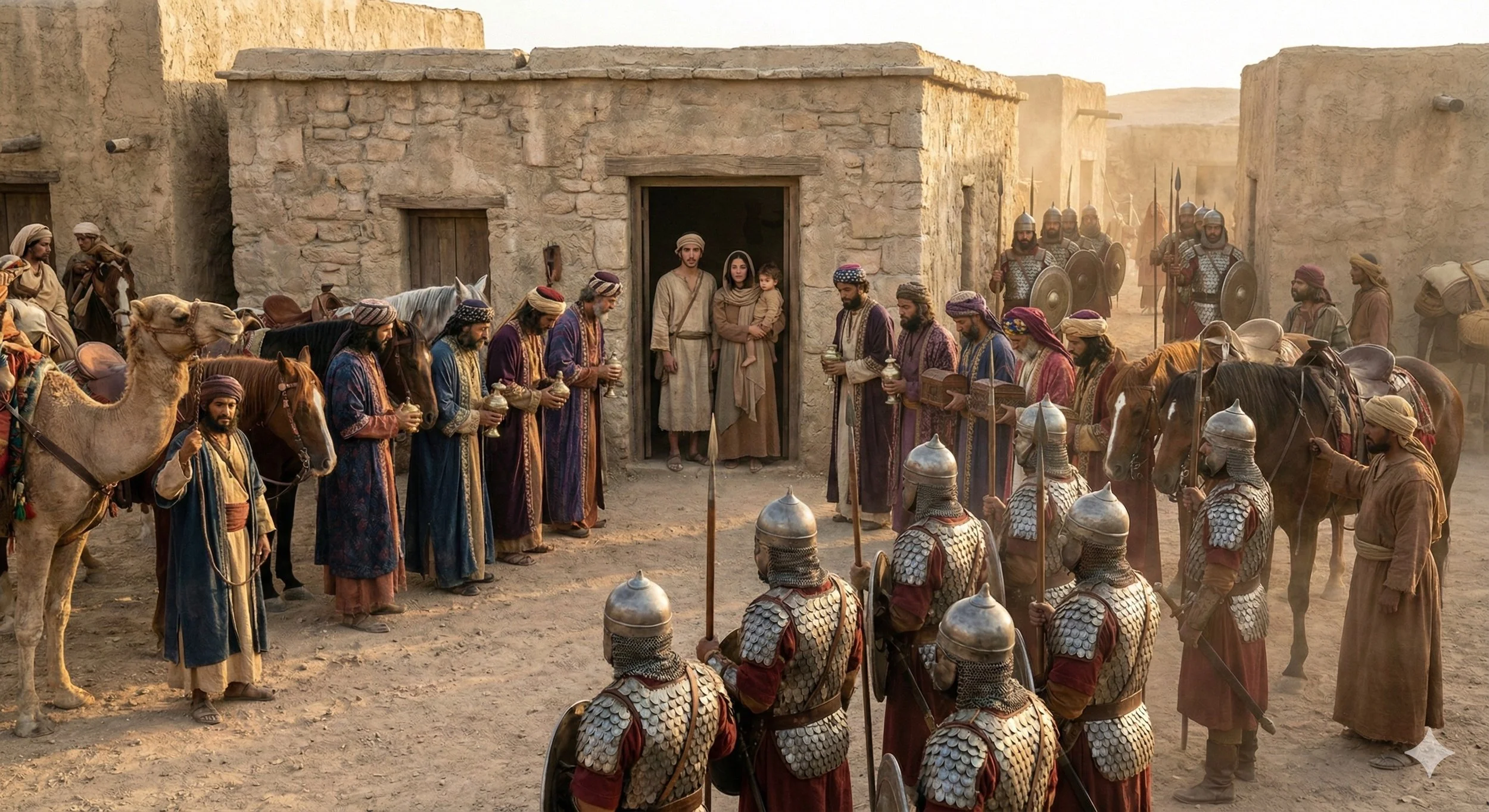
What it may have looked like when an unknown number of Magi arrived with their entourage.
The Bible is such an amazing treasure of information about the past as well as a key to understanding current and future events in our world. As you likely know, the key focus of Scargazers is to highlight the scar left behind from the largest catastrophic event in the history of the earth: the Flood of Noah's day, which occurred roughly 4,500 years ago. Only by reading the Bible's account of the year-long preparation followed by the year-long flood event can we have an accurate insight into the amazing geologic places in our world today.
That was certainly the most catastrophic event in the history of mankind, but it wasn't the most important. The arrival of Jesus, the Christ, to live, teach, die, and resurrect from the dead to redeem the world from the damage done by Adam and Eve’s rebellion was the most important. Since we just finished celebrating His birth, I thought I'd end this year with a side story that is often not known or understood, the visit of the Magi to bring gifts and worship the new King. As we explore, I'll share my two favorite ways to learn from the Bible—what it says, and what it does not say.
The Prophecy about Cyrus
As we begin the story of Christ's birth, let's travel back nearly 700 years to an unusual place to see the beginning of a key side story leading up to His birth. God knew the Jewish leaders would be in one of their periods of corruption during the time when Jesus was to come to the earth as a man, so He set in motion a side story that I find very intriguing.
This story begins in the Old Testament book of Isaiah written hundreds of years before all the events would come together. In Isaiah 44:28 we read, "It is I who says of Cyrus, 'He is My shepherd! And all My good pleasure he will complete.' And saying of Jerusalem, 'She will be built,' and of the temple, 'Your foundation will be laid.'" In that verse we get introduced to a man named Cyrus who wasn't even born yet. Better yet, he would come along some time in the future and would be God's servant to facilitate the return of the Jewish captives to Jerusalem. But wait—Jerusalem was a strong, vibrant, Jewish city, so did they even understand what Isaiah wrote?
Sometime around 100 years after that prophecy was made by Isaiah, a Babylonian king named Nebuchadnezzar invaded, captured, and destroyed Jerusalem. He destroyed the city and the temple made by King Solomon and either killed or took captive most of the inhabitants, moving them far away to the Babylonian kingdom. Now Isaiah's prophecy might have seemed a little more realistic, but the mystery of Cyrus was still in the future.
Daniel and the Magi
One of those young Jewish captives from Jerusalem was named Daniel, and the king included him in the Babylonian school so he could be reeducated in the ways of the Babylonians. During his schooling, he was recognized as being wise and gifted, so he was assigned to Nebuchadnezzar's group of Magi. Soon thereafter he rose in prominence after successfully claiming that his God could reveal the meaning of one of the king's troubling dreams. After that event, Daniel was elevated to the chief of the Magi in the Babylonian kingdom.
The book of Daniel gives many accounts of the time when the Jewish nation was held captive in the Babylonian kingdom. I encourage you to read or listen to the whole book in one sitting—Daniel had quite an amazing life.
As with all powerful kingdoms, they eventually come to an end, and so it was with the Babylonian kingdom. As we understand the succession after Nebuchadnezzar, his son became king, and while he was away for a time, he left his son Belshazzar in his place as king in Babylon. The expression we use today, "the writing on the wall," came from the time when a hand miraculously appeared and literally wrote on a wall during a big party hosted by King Belshazzar in Babylon, proclaiming to him that his kingdom was over and the Persian army was already in the city.
The Babylonian kingdom was overthrown in one day, and the king was killed that night. The Persian king in Susa during the capture of Babylon was none other than King Cyrus, the one prophesied by Isaiah. So now this formerly unknown Cyrus person has a key role in our story—he's the leader of the kingdom that inherited the captured Jewish nation right before the timing of their return. That must have been encouraging to the people of the nation of Israel who knew their Bible. All the parts were now in place for them to return to their land, the land promised to Abraham, Isaac, and Jacob, and to the city of their ancestors David and Solomon, who had designed and built the temple in Jerusalem.
Daniel was now an older man but still part of the leadership, now just under a new king, Cyrus, and a new kingdom, Persia. He became one of the top three leaders of the newly combined Babylonian and Persian empire and then got promoted to second in charge directly under Cyrus, overseeing all others, including the highly regarded group of Magi.
Much like our day, the quest for human power and jealousy often leads to assassination attempts, and such was the story of those Persians who now reported to a Jewish leader. We don't know exactly why, but a quick look at human nature tells us they were likely jealous of Daniel's promotion. To bring an end to their misfortune, they orchestrated a series of events that led to Daniel getting tossed into a den of lions for him to be eaten and destroyed. They obviously missed how God favored Daniel and how Cyrus was God's shepherd, so after God miraculously preserved Daniel with the lions, King Cyrus had all the conspirators and their families tossed into the den in place of Daniel.
The Bible doesn't say, but I'm sure Daniel and Cyrus created an unusual and even stronger bond that day, and Daniel likely may have selected the people to replace the now-eaten Magi.
The Decrees of Cyrus
This is where it all starts to connect. During his reign, Cyrus made two decrees relevant to our story, just as Isaiah had predicted. The first was the decree for the captured Jews to return to Jerusalem to rebuild their city and its walls. The second was for more of them to return and rebuild the temple that was destroyed by Nebuchadnezzar's army, even giving them all the stolen instruments used in the temple. In both cases, Cyrus provided money, protection, and building materials for the journey and the building project.
That was the temple visited by Jesus, and that's the temple that Jewish people today celebrate the completion of during Hanukkah. In Daniel 9:25-26, Daniel was visited by an angel named Gabriel, the same Gabriel that visited Mary before she became pregnant with Jesus. He gave many insights to Daniel, and likely some that weren't recorded for us to know, but the key was the timing of the arrival of the Messiah. In Daniel’s prophesy, the number of days were foretold from the decree of Cyrus to rebuild Jerusalem’s walls to the Messiah, and many scholars have calculated the days and arrived at the real Palm Sunday in Jerusalem a few hundred years later. After the years of Jesus’ time in Israel, that was the first time He allowed His followers to pronounce Him as their King.
What Did Daniel Know?
What else did Daniel know about the arrival of the Messiah? We don't know too much, but I find it interesting that a group in Persia knew more about the expected arrival of the Jewish Messiah than the Jewish leaders of that day.
How did they know? Did Daniel create a group of Jewish Magi after the conspirators were eaten by the lions? Were they Jewish or were they Persian?
We don't know much, but here's what we do know, based on the account in the New Testament book of Matthew (Matthew 2:1-12):
The Magi came from the east, but where in the east? We don’t exactly know but the last mention of the Magi prior to the New Testament was in the book of Daniel, and Daniel was a leader in Persia. It's interesting that due east of Bethlehem is Susa, the capital of Persia.
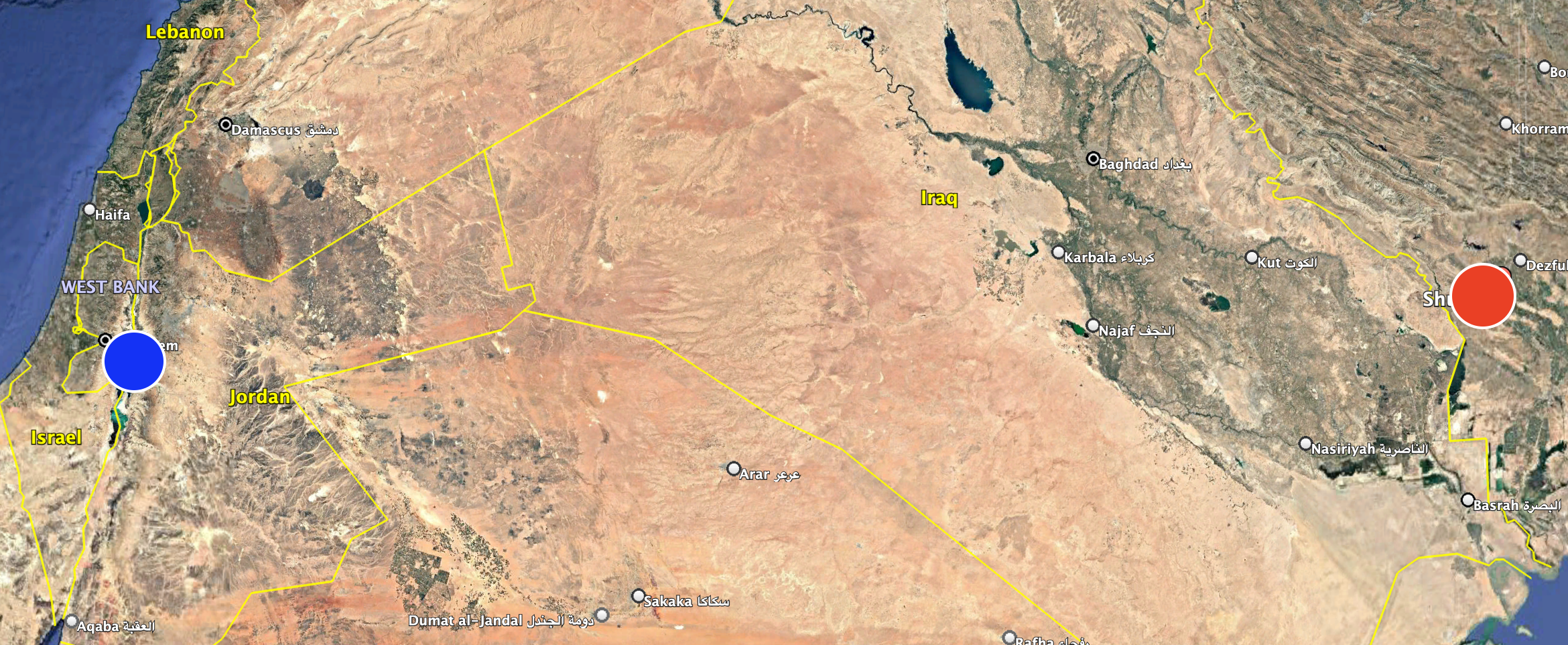
Map 1 - Bethlehem in blue, Susa in red. They are nearly due east and west of each other.
The Magi who were alive when Jesus was born were looking for His star. How did they know to look for the star of the Jewish Messiah?
We don't know how many Magi came to worship Jesus, but we do know there it was more than one since all references are plural. The idea that there were three was only devised from the mention of three types of gifts. Some groups in the Eastern Orthodox Church believe the number was twelve, but the Bible is silent on the actual number.
How many gifts were brought? We don't know how many gifts the Magi brought. We only know what types of gifts were brought: gold, frankincense, and myrrh.
Why didn't the Magi know the Messiah would come from Bethlehem? We don't know, but we do know their visit to Jerusalem caused quite a stir as recorded in verse 3. Maybe that was God's intention, to give the Jewish leaders one more chance.
It is interesting that there is no mention of any member of the Jewish leadership group accompanying them to investigate the claim of the Messiah’s birth.
Putting It All Together
Here's how I see it all coming together, based on a combination of what we know and what we don't know but can be easily plausible.
God knew that the Jewish leaders in power at the time Jesus was to arrive would be a corrupt group that held on to as much power as the Romans would allow and who had no tolerance for anything that would disrupt their grasp. So maybe God planted a message with a select group of Magi chosen by Daniel while in Persia. That message would exist for a few hundred years outside the power structure in Jerusalem, so when the Magi saw the star, they knew what to do.
It's almost a 1,000-mile journey from Susa to Jerusalem, so it was no small journey. They likely needed to go to the Persian king for permission, supplies, and an armed escort for their journey, all possibly decreed a few hundred years earlier during the reign of Cyrus. The Magi and their military and supply escorts could have easily been a large group, so it's no wonder their arrival into Jerusalem would have caused a big uproar.
It is reasonable to envision camels whenever there's a story of the Middle East, but horses were also commonly used. There's even a breed from that area called Arabian horses, so there could have been a mix of animals included in the escort.
We don't know when they saw the star, but if it first appeared when Jesus was born, it could easily take a year for them to get permission, gather supplies, and make the journey. We only get a tiny clue about the timing. When the Magi secretly left, the Roman king in Jerusalem ordered the killing of every male child in Bethlehem under the age of two. Based on this account, and Joseph being told by an angel right after the Magi left to flee Bethlehem and go to Egypt, Jesus was likely not a newborn as depicted in most nativity scenes.
The Magi likely traveled 1,000 miles to deliver gifts and to worship this new King, then they returned home for another 1,000 miles. What message could possibly be that important?
A message from God about the most important “person” in all history that began with the prophet Isaiah hundreds of years earlier.
How cool is that for a little side journey!