
#10 - Petrified Trees and the Flood
4/15/26
As a hobbyist woodworker, I have a heightened appreciation for petrified wood. Have you ever picked up a piece and really looked at it? You can still see the wood grain, the growth rings and sometimes even the texture of the bark, but it's solid stone. Something remarkable happened to that tree, and it happened fast enough that the wood didn't have time to decay. How it happened and how long it took is what we want to dig into in this newsletter.
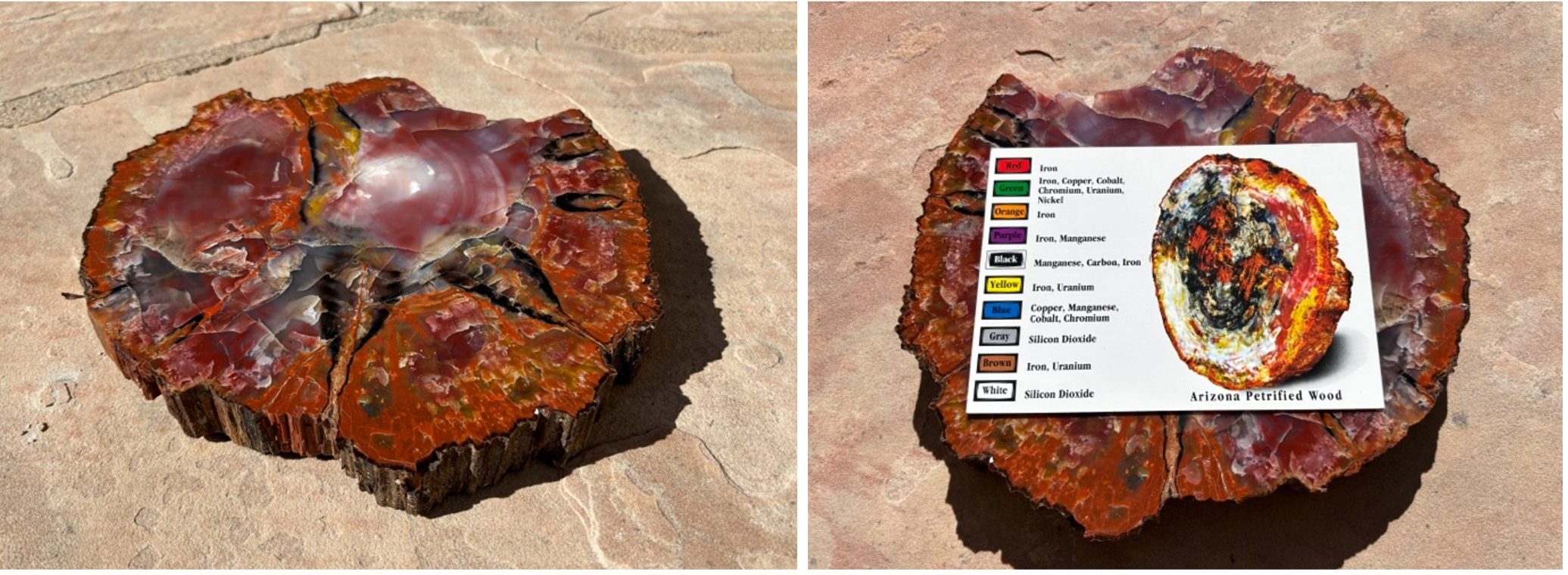
Photo 1 - A piece of petrified wood we purchased, along with the colored mineral chart
We're going to compare three places that many people visit without realizing they're part of the same story: Petrified Forest National Park in Arizona, the petrified forests at Yellowstone in Wyoming, and Mount St. Helens in Washington. Each one is fascinating on its own, but together they present a story that lines up perfectly with what the Bible describes.
Two Ways to See the Same Evidence
As always, the evidence is the same for everyone. It's where you start that determines what you see.
The standard interpretation you'll find at most visitor centers is that petrified wood forms over millions of years through slow mineral replacement and that layers of upright trees represent forests buried over long stretches of time. That view starts with the assumption that present-day slow processes are the key to understanding the past.
Our worldview here at Scargazers starts with the Word of God. The Bible tells us the earth is roughly 6,000 years old and that a catastrophic worldwide flood reshaped the entire planet approximately 4,500 years ago. If that's true, we should expect to find evidence of rapid, large-scale burial of plants and animals all over the world, and that's exactly what we find. The petrified forests are a perfect example.
Petrified Forest National Park, Arizona
The first thing that strikes you at Petrified Forest National Park is that none of the trees are standing. They're all lying down, scattered across the landscape like a lumberyard got hit by something enormous. The logs are broken into pieces, stripped of bark and branches, and their roots are missing. Fossils of fish, ferns, and massive crocodile-like reptiles are buried in the same rock layers right alongside them.
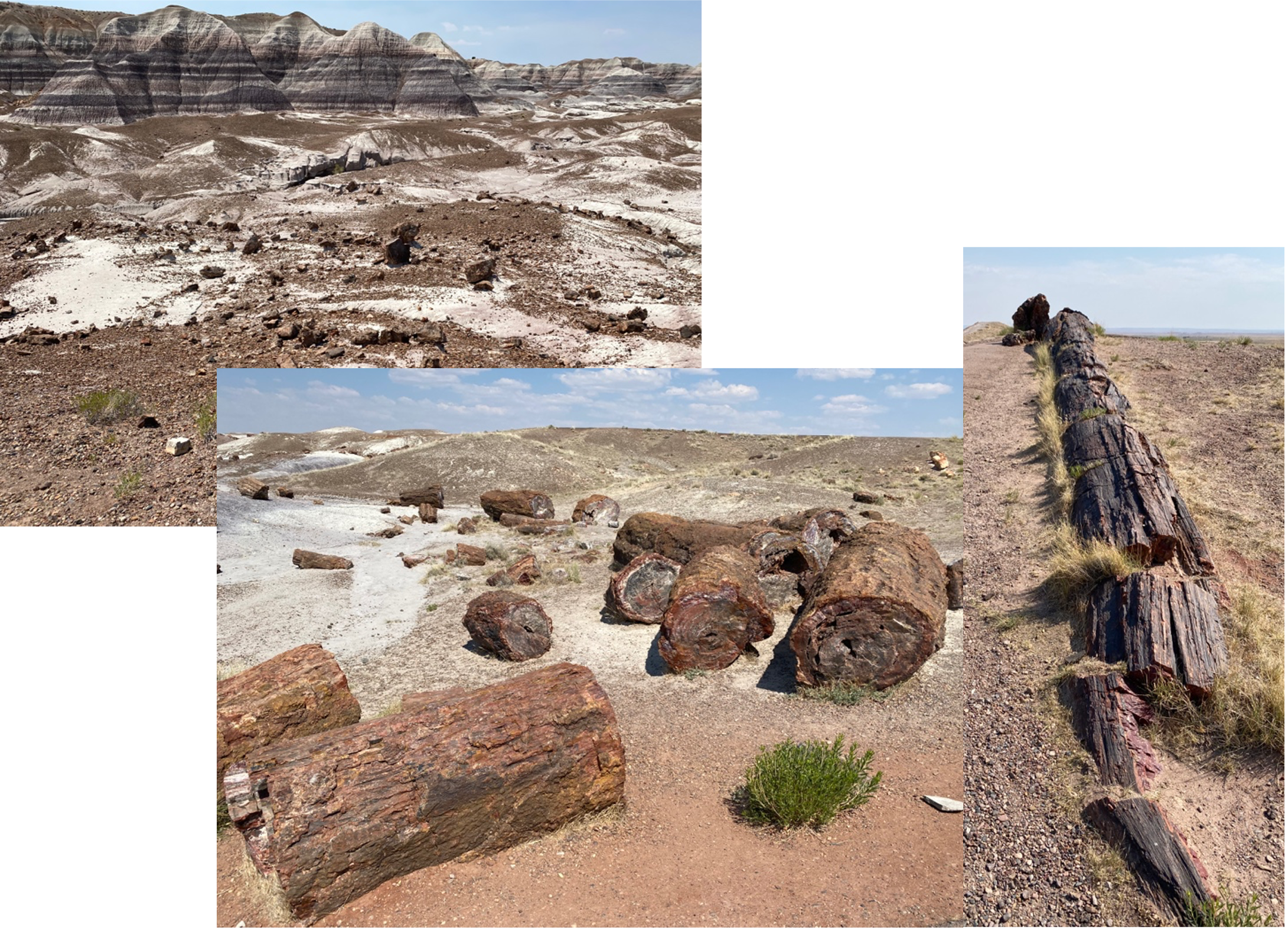
Photo Group 2 - Here’s how logs are found in Arizona, nearly all are broken, many are in debris piles
Here's something worth considering, wood rots. Leave a log in a moist environment and within a few decades it's gone. For wood to turn to stone, it needs to be buried quickly, cut off from oxygen, and soaked in mineral-rich water that replaces the organic material with silica and quartz. Scientists have produced petrified wood in the lab in a matter of hours under the right conditions. Time is not the key ingredient, conditions are.
The conditions of a worldwide flood (sediment-laden water, volcanic ash in suspension, and rapid burial) would have been ideal for exactly this kind of preservation. Looking at those logs scattered across the painted desert, we don't see a slow river delta. We see a catastrophic deposit where trees were swept in by floodwaters, buried under volcanic ash, and locked in mineral-rich water long enough to turn wood into stone.
Yellowstone National Park
Now let's travel north to Yellowstone where petrified forests were considered one of the strongest arguments against a young earth point of view.
At Specimen Ridge in the Lamar Valley, erosion has exposed layers of upright petrified trees stacked one on top of another. There are about 27 such layers at Specimen Ridge alone, and over 50 at nearby Specimen Creek, with the whole sequence stretching over 3,400 feet thick.
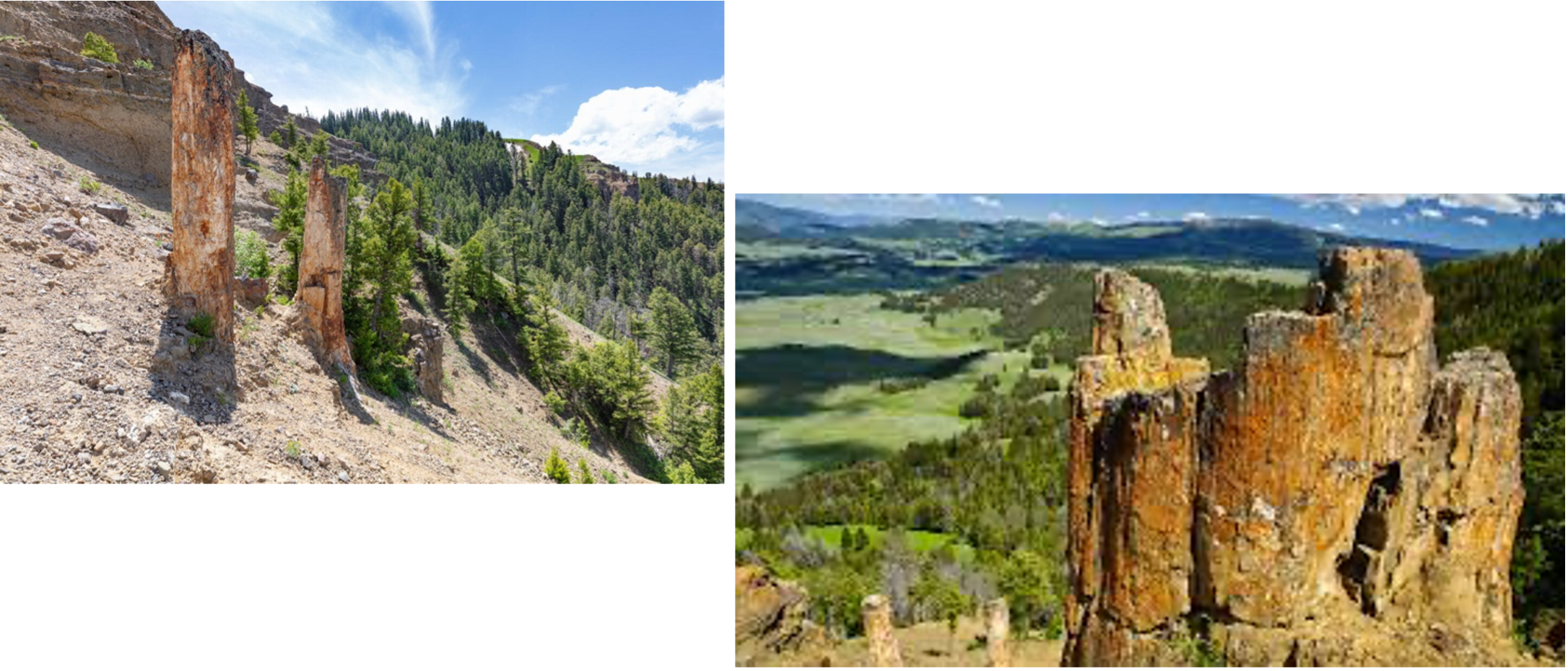
Photo Group 3 - Specimen Ridge in Yellowstone National Park
The standard interpretation is that each layer represents a separate forest that grew in place, was buried by a volcanic eruption, petrified over centuries, and then had new soil form on top so another forest could grow, repeated over and over for tens of thousands of years.
That sounds reasonable until you look at the actual evidence. Growing forests develop rich soil, thick layers of organic debris, root systems, and animal activity. If each layer represented a real forest floor, you'd expect thick bands of developed soil between each level. Instead, the average organic layer between levels is only about one inch thick, with no roots, no clay and no developed soil. The sediments show signs of water-driven deposition, not ash settling quietly onto a stable forest floor.
Then there are the trees. Growing trees develop root systems that can represent 20 to 30 percent of their total mass, but the Yellowstone petrified trees have their roots broken off cleanly, leaving only a root ball. That's exactly what happens when trees are uprooted and transported by moving water. The tops of some upright trunks even extend into the layer above them. If each layer required hundreds of years to form, any exposed trunk would have fully rotted before the next layer arrived, yet the wood is perfectly preserved right through those boundaries.
So how did those trees end up standing upright in multiple layers if they didn't grow there? That's where Mount St. Helens comes in.
The Key: Mount St. Helens and Spirit Lake
On May 18, 1980, Mount St. Helens erupted with the energy equivalent to roughly 20,000 Hiroshima-sized atomic bombs. The blast knocked down 150 square miles of forest in six minutes, and a massive wave on Spirit Lake stripped trees from slopes as high as 850 feet above the lake's surface. By that afternoon, an estimated one million logs were floating on the water.
Dr. Steve Austin, a geologist with the Institute for Creation Research, began studying Spirit Lake in the years that followed, and what his team discovered there was remarkable.
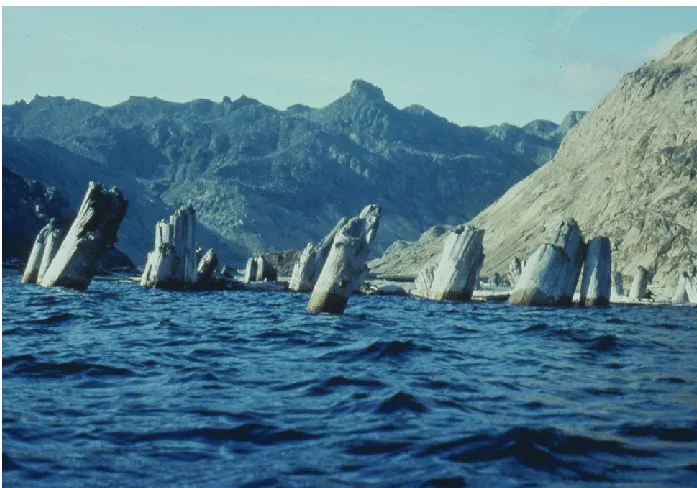
Photo 4 - Logs floating vertically in Spirit Lake, many have sunk to the bottom
Many of the floating trees showed a strong tendency to float upright, root ball down, top end in the air. The denser root end absorbs water faster, so it sinks while the lighter trunk end stays buoyant. Think about that for a moment. These logs were floating like giant fishing bobbers.
Over the following years, roughly half the logs sank. Austin's team used sonar and scuba gear to survey the lakebed and found an estimated 19,000 logs standing upright at varying depths in the sediment, giving every appearance of multiple layers of trees deposited at different times.
But they all entered the lake on the same day.
If Spirit Lake were drained and examined thousands of years from now, a geologist working from a slow-processes worldview would almost certainly interpret it as evidence of multiple forests buried over a very long period of time. That is exactly how Yellowstone's Specimen Ridge has been interpreted for most of the last century.
Three Sites, One Story
Step back and look at all three places together.
In Arizona, we see massive trees stripped of bark and branches, rapidly buried in volcanic ash and mineralized into stone. In Wyoming, we see dozens of layers of upright trees with broken roots, missing bark, and trunks that pass through many sedimentary layers without a trace of decay, every mark pointing to transport by water rather than growth in place. In Washington, we see a living, documented example of how a catastrophic event can strip a forest, float the trees upright, sink them in layers that look like successive forests, and set the stage for rapid mineralization.
Mount St. Helens was a relatively small event by geological standards. The volcanic activity of a worldwide flood would have been vastly larger. What we see at Spirit Lake is a scale model, and what we see preserved in Arizona and Wyoming may be what that model looks like when it operates across an entire planet.
What It All Means
Every scar has a story. Those colorful logs scattered across the painted desert, and those upright petrified stumps stacked in the cliffs of Yellowstone, are not just interesting geological features. They're witnesses to a real event that the Bible describes in detail.
God judged the ancient world through the flood, and the evidence of that judgment is literally turned to stone all over the earth. But the same God who judged also provided rescue through the ark, and that same rescue is available to us today through Jesus Christ.
The next time you see a piece of petrified wood, pick it up and think about the story behind its transformation from wood to stone. God preserved a remnant of the forests that existed prior to the flood using a catastrophic event so we can see them today, what a gift He has left for us to discover.
-Greg and Sheila
For more on Dr. Steve Austin's research, visit the Institute for Creation Research at icr.org, or check out the documentary "Is Genesis History?" which we highly recommend.